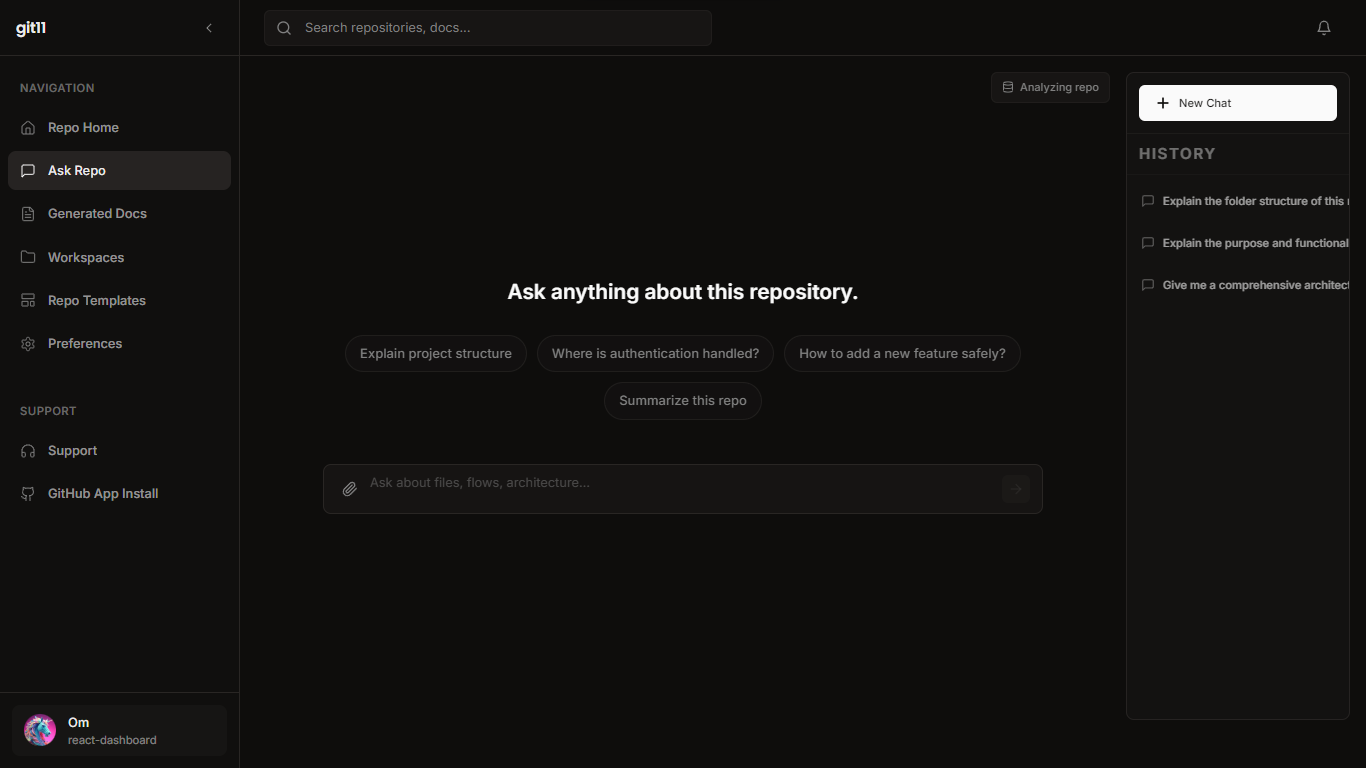
The End of Manual Code Audits
Large language models have reduced the time required to map new codebases from days to seconds.
By git11 Engineering · Mon Mar 16 2026 · 7 min read

A developer spends 70% of their time reading code rather than writing it. This ratio describes the fundamental bottleneck in software engineering. We are moving from a world of manual tracing to automated semantic indexing.
Traditional tools like grep or ctags identify strings and definitions. They fail to explain intent or side effects. If you open a 500,000-line repository like tensorflow/tensorflow, you cannot find the core execution logic by searching for keywords. You need a mental model of the data flow.
AI provides this model instantly by mapping the relationships between disparate components. We no longer rely on brittle regex patterns to find where a variable is mutated. We use vector embeddings to represent the functional identity of a code block.
The Failure of Grep
Manual codebase exploration relies on a set of unreliable signals. You look for file names like auth.py or search for strings like API_KEY. This method fails in polyglot repositories where logic is split across Go services and Rust modules.
Legacy static analysis builds a Call Graph. These graphs grow exponentially in complexity and quickly become unreadable for humans. A standard microservice might generate a dependency map with 4,000 nodes. No engineer can internalize that structure in one sitting.
When you ask "where is the rate limiting logic implemented," a traditional search returns every instance of the word rate. In a large system, this might be 1,200 matches across config/, middleware/, and tests/. It provides data but zero context.
AI bypasses the search phase by indexing the abstract syntax tree (AST) alongside natural language descriptions. It understands that a function named shaper() in a networking context is likely performing rate limiting. This is the difference between keyword matching and semantic comprehension.
Mapping Dependency Chains
Codebase understanding is essentially a graph traversal problem. You start at an entry point, like main.go or index.ts, and follow the imports. You do this to build a local map of how data moves through the system.
Large language models automate this traversal by pre-calculating the impact of changes. If you modify a schema in db/models.py, the AI identifies every downstream consumer. It identifies these not just by name, but by the structural shape of the data being passed.
- It identifies orphans and dead code that compilers miss.
- It maps implicit dependencies across message brokers like RabbitMQ.
- It connects frontend API calls to backend controller methods without shared types.
- It detects where logic in
pkg/authconflicts with rules in.github/workflows.
This visibility changes how we perform security audits. You no longer have to manually verify that every route in routes/api.php uses the auth middleware. The model flags routes that deviate from the established architectural pattern of the repository.
Extracting Architectural Intent
Most legacy codebases lack up-to-date documentation. The README is three years old and the comments describe what the code does, not why. The latent space of an LLM contains the missing "why."
We provide the model with the entire repository context. It looks at the commit history, the package.json constraints, and the helper functions. It derives the engineering philosophy of the original authors from the code itself.
- The model ingests the file structure to identify the design pattern (e.g., Clean Architecture or Hexagonal). 2. It analyzes the
test/directory to understand the expected behavior of edge cases.
- It compares the implementation against known industry standards for that specific stack. 4. It generates a high-level summary that maps the physical files to logical concerns.
If you are a new hire, you don't need a three-week onboarding period. You ask the model: "How does the caching layer handle cache invalidation during a partial write?" The model points to internal/cache/redis.go:142 and explains the retry logic.
Refactoring via Contextual Awareness
Refactoring is often dangerous because of side effects. Most developers stick to small, local changes because they fear breaking a remote part of the system. AI removes this fear by providing a global context window.
When we suggest a refactor from axios to fetch, we aren't just doing a find-and-replace. The tool analyzes how the interceptors in utils/api.ts must be rewritten to match the new API. It ensures the error handling blocks in 40 different files stay compatible.
- It detects repeated logic patterns that should be abstracted into a shared module.
- It identifies where types are cast to
anyand suggests the correct interface. - It finds hardcoded configurations that should be moved to
.envfiles. - It suggests performance optimizations based on the specific data structures used in the file.
This goes beyond simple linting. It is the difference between a spellchecker and an editor. The linter sees the syntax; the AI sees the architecture.
The Cost of Manual Reading
Manual reading is expensive. If a senior engineer earns $180,000, their time costs roughly $90 per hour. If they spend four hours a day just trying to understand existing code, that is $360 per day per engineer.
In a team of 50, that is $18,000 daily spent on the overhead of code comprehension. This is a tax on every feature you ship. AI tools eliminate this tax by making the codebase searchable in plain English.
We are seeing a shift where repositories are no longer treated as collections of files. They are treated as queryable databases. You don't read the code; you ask the code questions.
Technical Implementation of Context
To achieve this, we use a technique called Retrieval-Augmented Generation (RAG). We don't just dump the code into a prompt. We chunk the files into logical segments based on the AST.
Each chunk is converted into a vector and stored in a database like Pinecone or Milvus. When you ask a question, we retrieve the most relevant 20 chunks of code. These chunks provide the "ground truth" for the LLM to generate an answer.
- We exclude large binary files and lockfiles like
yarn.lockto save tokens. - We prioritize
d.tsand header files to understand interfaces first. - We use tree-sitter to parse the code into a format the model can navigate.
- We weight recent commits more heavily to ensure the information is current.
This pipeline allows us to handle repositories with millions of lines of code. The model doesn't need to see every line at once. It only needs to see the lines that matter for the current query.
The Future of the Repository
The repository is becoming a live documentation site. Every pull request update triggers a re-indexing of the semantic map. The documentation no longer goes out of date because the documentation is a projection of the code.
You stop writing documentation for humans. You write code that is clear enough for the AI to index, and the AI explains it to the humans as needed. This reduces the cognitive load on the developer significantly.
We are approaching a point where the "onboarding" process is obsolete. A developer can contribute to a complex C++ engine on their first day because they have an AI navigator. The barrier to entry for complex systems is falling.
Engineers will move from being readers to being directors. You spend your energy on the system's goals while the AI manages the implementation details of the existing codebase. This is the only way to manage the increasing scale of modern software.
Stop reading every line of the libraries you import. Use a tool that has already read them and can tell you exactly what you need to know.
Code comprehension is no longer a human-scale problem.