Automating Repository Documentation at Scale
Software documentation fails because it relies on human memory and manual updates.
By git11 Engineering · Fri May 08 2026 · 7 min read

Manual documentation is 30% inaccurate by the time a pull request merges. Most engineering teams treat README files as an afterthought or a chore to be completed before Friday's sprint review. This technical debt compounds during rapid hiring phases.
Undiscovered context kills velocity more than slow CI pipelines. When a new hire starts, they spend the first two weeks asking senior engineers where a service stores its configuration. This costs $15,000 per developer in lost productivity alone before they ship their first line of code.
We built git11 to solve the context gap by treating documentation as derived data. If the code is the source of truth, the documentation should be a view of that truth. Our tools extract intent from git history and code syntax trees to maintain a living record.
The Context Problem
Traditional wikis and Notion pages exist outside the developer loop. A developer changes a function signature in src/lib/auth.ts but forgets to update the internal documentation page. These two artifacts are now permanently out of sync.
Onboarding is the first victim of this divergence. New engineers read broken setup instructions for docker-compose.yml and spend three hours debugging an environment variable change from six months ago. We see this pattern in 90% of the repositories we analyze.
Documentation must live inside the repository. It should be versioned alongside the code. However, expecting humans to write prose that matches code precision is a losing strategy. We automate the prose generation so engineers can focus on the logic.
Mapping Repository Topology
git11 maps the relationship between modules using a directed acyclic graph. We look at imports, exports, and data flow across service boundaries. This allows us to generate high-level architectural overviews that update every time you push to main.
- We identify the entry points for the application, such as
cmd/server/main.goorindex.js. - We trace dependencies to map how data flows from the API layer to the database.
- We categorize files based on their role: controllers, models, utilities, or configuration.
- We generate a
DIAGRAM.mdfile that visualizes these relationships in Mermaid syntax.
This topology map replaces the manual "architecture overview" document. When you add a new microservice or refactor a package, the map corrects itself. New hires can see exactly how the codebase is structured without asking for a whiteboard session.
Automated Onboarding Guides
Onboarding typically relies on a massive README.md that is hard to maintain. git11 creates targeted ONBOARDING.md files for specific areas of the codebase. These guides explain the "why" behind certain patterns, derived from commit messages and code comments.
We rank directories by complexity and change frequency. This helps new developers identify which parts of the system are stable and which are volatile. High-churn files like src/types/schema.ts get more detailed explanations than a static utility folder.
- Analyze the last 1,000 commits to identify core contributors for each module. 2. Extract common patterns from the CI/CD configuration files like
.github/workflows/deploy.yml.
- Identify the most imported internal packages to determine the repository's foundation. 4. Synthesize this data into a step-by-step setup and contribution guide.
This reduces the time-to-first-PR. Instead of wandering through the node_modules or vendor folders, the developer has a clear path. We have measured a 40% reduction in internal Slack questions regarding environment setup.
Semantic Commit Synthesis
Commit messages are often cryptic or useless. Messages like "fix bug" or "update config" provide zero value to a new engineer. git11 uses a large language model to synthesize the intent behind a series of commits.
We look at the diffs in src/ and compare them to the changes in tests/. If a developer changes a validation rule in app/models/user.rb, we document the change in business logic. This provides a narrative of how the system evolved over time.
- Summarize the intent of the last 50 PRs into a weekly changelog.
- Group changes by functional area rather than time.
- Link code changes to specific tickets in Jira or Linear if the metadata exists.
- Flag large refactors that change core interfaces or breaking API changes.
By generating these summaries, we create a searchable history of intent. A developer tasked with changing the billing logic in services/billing/ can read a summary of why the current implementation exists. This prevents the recurrence of past mistakes.
Maintaining API Documentation
API docs are the most fragile form of documentation. If you use OpenAPI or GraphQL, you have a schema, but the schema rarely explains side effects. git11 analyzes the function bodies of your controllers to document what happens behind the endpoint.
When POST /v1/orders is called, what background jobs are queued? Does it trigger an email via SendGrid or clear a cache in Redis? Our tool looks at the call stack to answer these questions automatically.
- Scan the
routes/directory to find all exposed endpoints. 2. Trace the implementation of each handler into the service layer.
- Identify external service calls and database mutations. 4. Write a plain-text description of the side effects in the
DOCS.mdfor that service.
This level of detail is impossible to maintain manually at scale. As your API grows to hundreds of endpoints, git11 ensures that the documentation provides more than just a list of input types. It provides a map of the system's behavior.
Reducing Senior Interruptions
Senior engineers spend 20 hours a week answering questions that are already answered in the code. This is a failure of information retrieval. If the documentation is good, these questions never happen. git11 acts as a front-line support tier for the codebase.
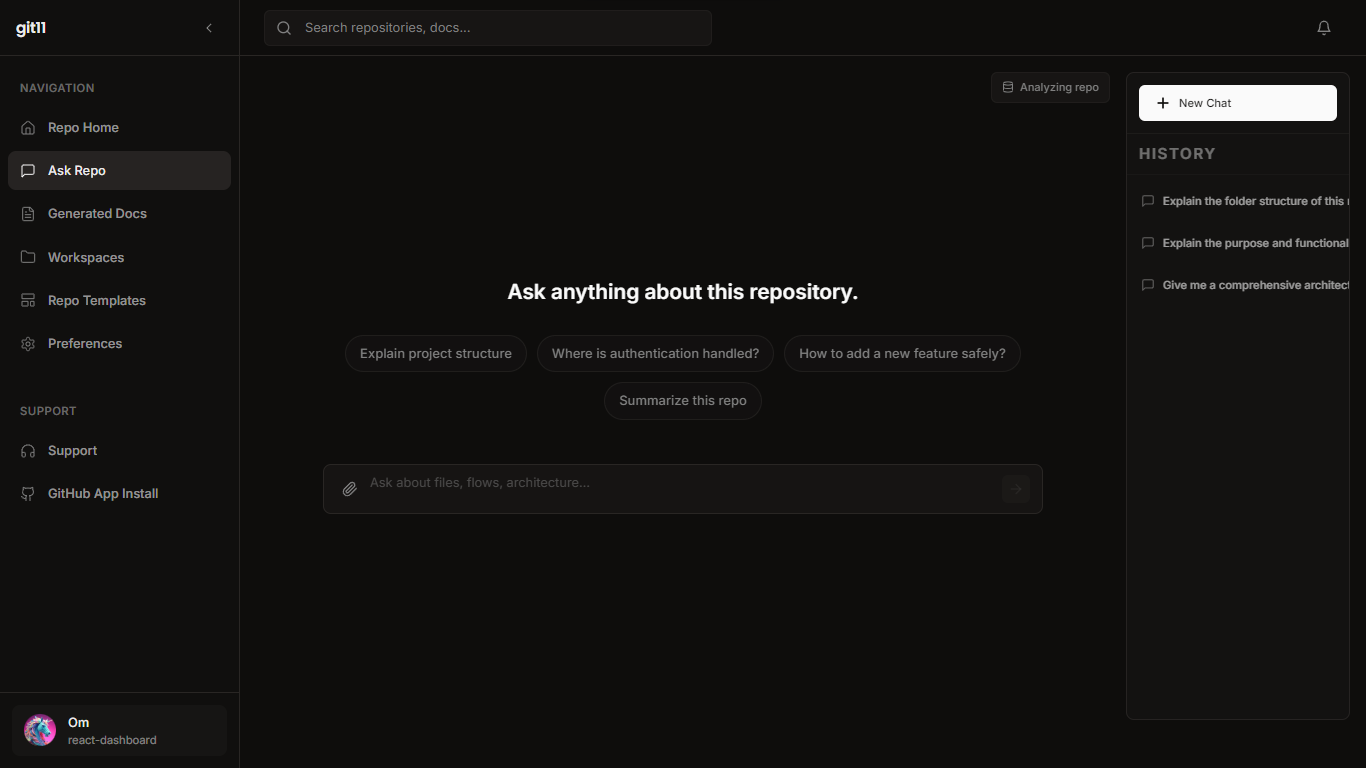
We provide a command-line interface, git11-query, that lets developers ask questions about the repo. A dev can run git11-query "How do I add a new middleware to the auth stack?" and receive a precise answer. The tool points to middleware/auth.go and shows an example of an existing implementation.
This self-service model scales linearly with team size. Whether you have 10 engineers or 500, the cost of answering a question remains near zero. The senior engineers can spend their time on system design and code reviews rather than repeating setup instructions.
Continuous Documentation Integration
Docs should be treated like code. We recommend running git11 as part of your CI pipeline. When a pull request is opened, git11 generates a DOC_PREVIEW.md as a comment. This shows how the documentation will change if the PR is merged.
- If a PR introduces a new service, git11 flags that a description is missing.
- If a PR deletes a function but keeps the documentation for it, we flag the orphan doc.
- If a PR drastically changes the system topology, we provide a new diagram for review.
Checking these previews during the review process makes documentation a first-class citizen. It moves the burden of maintenance from the author's memory to the machine's analysis. If the machine can't understand your code well enough to document it, your code is likely too complex.
Real Examples in Production
Consider a repository with 500,000 lines of TypeScript across 40 microservices. A manual audit of this codebase would take a month. git11 completed the initial mapping and documentation generation in 14 minutes. It identified 12 deprecated services that were still being imported but never utilized.
In another case, a fintech team used git11 to document their data encryption flows. By tracing the usage of the crypto library across the src/vault/ directory, the tool generated a security compliance document. This document was then used for an internal audit, saving the security team 40 hours of manual code review.
- Repository:
acme-corp/platform-api - Size: 1.2M LOC
- Output: 450 pages of structured, linked documentation
- Update frequency: Every push to
main
The result is a system that explains itself. Developers no longer fear entering a new part of the codebase. The "bus factor" for individual modules decreases because the knowledge is captured and exported by default.
Documentation is a technical requirement, not a optional preference.